SMART Goal
My SMART goal is to pass the AP exam in May and to attend a 4 year university where I will major in neuroscience, and eventually attend medical school to become a neurosurgeon.
Saturday, January 26, 2013

Monday, January 21, 2013
Lit Terms 6-30


6. Analogy: a comparison made between two things to show the
similarities between them
7. Analysis: a method in which a work or idea is separated into
its parts, and those parts given rigorous and detailed scrutiny
8. Anaphora: a device or repetition in which a word or words
are repeated at the beginning of two or more lines, phrases, clauses, or
sentences
9. Anecdote: a very short story used to illustrate a point
10. Antagonist: a person or force opposing the protagonist in a
drama or narrative
11. Antithesis: a balancing of one term against another for
emphasis or stylistic effectiveness
12. Aphorism: a terse, pointed statement expressing some wise or
clever observation about life
13. Apologia: a defense or justification for some doctrine,
piece of writing, cause, or action; also apology
14. Apostrophe: a figure of speech in which an absent or dead
person, an abstract quality, or something inanimate or nonhuman is addressed
directly
15. Argument(ation): the process of convincing a reader by
proving either the truth or the falsity of an idea or proposition; also, the
thesis or proposition itself
16. Assumption: the act of supposing, or taking for granted that
a thing is true
17. Audience: the intended listener or listeners
18. Characterization: the means by which a writer reveals a
character’s personality
19. Chiasmus: a reversal in the order off words so that the
second half of a statement balances the first half in inverted word order
20. Circumlocution: a roundabout or evasive speech or writing,
in which many words are used but a few would have served
21. Classicism: art, literature, and music reflecting the
principles of ancient Greece and Rome: tradition, reason, clarity, order, and
balance
22. Cliché: a phrase or situation overused within society
23. Climax: the decisive point in a narrative or drama; the pint
of greatest intensity or interest at which plot question is answered or
resolved
24. Colloquialism: folksy speech, slang words or phrases usually
used in informal conversation
25. Comedy: originally a nondramatic literary piece of work that
was marked by a happy ending; now a term to describe a ludicrous, farcical, or
amusing event designed provide enjoyment or produce smiles and laughter
26. Conflict: struggle or problem in a story causing tension
27. Connotation: implicit meaning, going beyond dictionary
definition
28.Contrast: a rhetorical device by which one element (idea or
object) is thrown into opposition to another for the sake of emphasis or
clarity
29. Denotation: plain dictionary definition(same image shown under #27)
30. Denouement (pronounced day-new-mahn): loose ends tied up in
a story after the climax, closure, conclusion
Thursday, January 17, 2013
Poetry Analysis
Dover Beach
The sea is calm tonight.
The tide is full, the moon
lies fair
Upon the straits; on the
French coast the light
Gleams and is gone; the cliffs
of England stand,
Glimmering and vast, out in
the tranquil bay.
Come to the window, sweet is
the night-air!
Only, from the long line of
spray
Where the sea meets the
moon-blanched land,
Listen! you hear the grating
roar
Of pebbles which the waves
draw back, and fling,
At their return, up the high
strand,
Begin, and cease, and then
again begin,
With tremulous cadence slow,
and bring
The eternal note of sadness
in.
Sophocles long ago
Heard it on the Ægean, and it
brought
Into his mind the turbid ebb
and flow
Of human misery; we
Find also in the sound a
thought,
Hearing it by this distant
northern sea.
The Sea of Faith
Was once, too, at the full,
and round earth’s shore
Lay like the folds of a bright
girdle furled.
But now I only hear
Its melancholy, long,
withdrawing roar,
Retreating, to the breath
Of the night-wind, down the
vast edges drear
And naked shingles of the
world.
Ah, love, let us be true
To one another! for the world,
which seems
To lie before us like a land
of dreams,
So various, so beautiful, so
new,
Hath really neither joy, nor
love, nor light,
Nor certitude, nor peace, nor
help for pain;
And we are here as on a
darkling plain
Swept with confused alarms of
struggle and flight,
Where ignorant armies clash by
night.
Dover Beach Analysis
Dover Beach Analysis
The speaker's tone was somber throughout the poem. The poem illustrates change, humanity, and the struggle for the truth. The imagery in this poem is breathtaking.
We Real Cool
By: Gwendolyn Brooks
THE POOL PLAYERS.
SEVEN AT THE GOLDEN SHOVEL.
We real cool. We
Left school. We
Lurk late. We
Strike straight. We
Sing sin. We
Thin gin. We
Jazz June. We
Die soon.
We real cool. We
Left school. We
Lurk late. We
Strike straight. We
Sing sin. We
Thin gin. We
Jazz June. We
Die soon.
We Real Cool Analysis
The speaker seems to be concerned about the community and tries to interpret the mind of one of the boys. The word "we" is repeated multiple times througout the poem which makes the reader assume that the boys have a group identity.
The speaker seems to be concerned about the community and tries to interpret the mind of one of the boys. The word "we" is repeated multiple times througout the poem which makes the reader assume that the boys have a group identity.
Safe in their Alabaster Chambers (124)
Safe in their Alabaster
Chambers -
Untouched by Morning -
and untouched by noon -
Sleep the meek members of the
Resurrection,
Rafter of Satin and Roof of
Stone -
Grand go the Years,
In the Crescent above them
-
Worlds scoop their Arcs
-
and Firmaments - row -
Diadems - drop -
And Doges surrender -
Soundless as Dots,
On a Disk of Snow.
Safe in their alabaster chamber Analysis
The speaker talks about death throughout the poem and tells the reader that no matter what you do in your lifetime; when you die you are nothing. The more of the poem that you read, the more you realize that the speaker is talking about the nature of death.
The speaker talks about death throughout the poem and tells the reader that no matter what you do in your lifetime; when you die you are nothing. The more of the poem that you read, the more you realize that the speaker is talking about the nature of death.
Mending Wall
Something there is that
doesn't love a wall,
That sends the
frozen-ground-swell under it,
And spills the upper boulders
in the sun;
And makes gaps even two can
pass abreast.
The work of hunters is another
thing:
I have come after them and
made repair
Where they have left not one
stone on a stone,
But they would have the rabbit
out of hiding,
To please the yelping dogs.
The gaps I mean,
No one has seen them made or
heard them made,
But at spring mending-time we
find them there.
I let my neighbour know beyond
the hill;
And on a day we meet to walk
the line
And set the wall between us
once again.
We keep the wall between us as
we go.
To each the boulders that have
fallen to each.
And some are loaves and some
so nearly balls
We have to use a spell to make
them balance:
"Stay where you are until our
backs are turned!"
We wear our fingers rough with
handling them.
Oh, just another kind of
out-door game,
One on a side. It comes to
little more:
There where it is we do not
need the wall:
He is all pine and I am apple
orchard.
My apple trees will never get
across
And eat the cones under his
pines, I tell him.
He only says, "Good fences
make good neighbours."
Spring is the mischief in me,
and I wonder
If I could put a notion in his
head:
"Why do they make
good neighbours? Isn't it
Where there are cows? But here
there are no cows.
Before I built a wall I'd ask
to know
What I was walling in or
walling out,
And to whom I was like to give
offence.
Something there is that
doesn't love a wall,
That wants it down." I could
say "Elves" to him,
But it's not elves exactly,
and I'd rather
He said it for himself. I see
him there
Bringing a stone grasped
firmly by the top
In each hand, like an
old-stone savage armed.
He moves in darkness as it
seems to me,
Not of woods only and the
shade of trees.
He will not go behind his
father's saying,
And he likes having thought of
it so well
He says again, "Good fences
make good neighbours."
Mending Wall Analysis
The theme of the poem is that the speaker blames nature for all the damages to the wall. As the poem progresses it is harder to understand the speaker's take on the wall.
To His Coy Mistress |
||
| By: Andrew Marvell | ||
Had we but world enough, and time,
This coyness, Lady, were no crime.
We would sit down and think which way
To walk and pass our long love's day.
Thou by the Indian Ganges' side
Shouldst rubies find: I by the tide
Of Humber would complain. I would
Love you ten years before the Flood,
And you should, if you please, refuse
Till the conversion of the Jews.
My vegetable love should grow
Vaster than empires, and more slow;
An hundred years should go to praise
Thine eyes and on thy forehead gaze;
Two hundred to adore each breast;
But thirty thousand to the rest;
An age at least to every part,
And the last age should show your heart;
For, Lady, you deserve this state,
Nor would I love at lower rate.
   But at my back I always hear
Time's wingèd chariot hurrying near;
And yonder all before us lie
Deserts of vast eternity.
Thy beauty shall no more be found,
Nor, in thy marble vault, shall sound
My echoing song: then worms shall try
That long preserved virginity,
And your quaint honour turn to dust,
And into ashes all my lust:
The grave's a fine and private place,
But none, I think, do there embrace.
   Now therefore, while the youthful hue
Sits on thy skin like morning dew,
And while thy willing soul transpires
At every pore with instant fires,
Now let us sport us while we may,
And now, like amorous birds of prey,
Rather at once our time devour
Than languish in his slow-chapt power.
Let us roll all our strength and all
Our sweetness up into one ball,
And tear our pleasures with rough strife
Thorough the iron gates of life:
Thus, though we cannot make our sun
Stand still, yet we will make him run.
His Coy Mistress Analysis
The speaker sounds very flattering when he describes the lady. He has a way with words and charms
the reader. Death is most likely a theme of the poem because a description of the afterlife recieves a
whole stanza.
Sources: (http://edsitement.neh.gov/feature/twenty-one-poems-ap-literature-and-composition#01)
| ||
Tuesday, January 15, 2013
Literature Terms 1-5
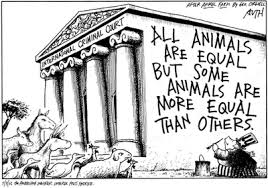
(I am confused.......)
(Try saying that 5 times fast:)

(You have no idea who he is talking about.)
1. Allegory: a tale in prose or verse in which characters,
actions, or settings represent abstract ideas or moral qualities; a story that
uses symbols to make a point
2. Alliteration: the repetition of similar initial sounds,
usually consonants, in a group of words
3. Allusion: a reference to a person, a place, an event, or a
literary work that a writer expects a reader to recognize
(Everytime you see this picture, your mind thinks of something dirty.)
4. Ambiguity: something uncertain as to interpretation
(You have no idea who he is talking about.)
5. Anachronism: something that shows up in the wrong place or
the wrong time
(This video speaks for itself:)
(This video speaks for itself:)
Sunday, January 13, 2013
Spring Semester Plan 1
I hope that during the spring semester that I keep the momentum I had during the fall semester so I don't get senioritis. My goal for the spring semester is to acquire as many tools from the Internet as possible to help me in my future college classes. My other goal for the spring semester is to stay focused so I am able to pass the AP Exam at the end of the year.
I hope that during the spring semester that I keep the momentum I had during the fall semester so I don't get senioritis. My goal for the spring semester is to acquire as many tools from the Internet as possible to help me in my future college classes. My other goal for the spring semester is to stay focused so I am able to pass the AP Exam at the end of the year.
Thursday, January 10, 2013
AP PREP POST 1: SIDDARTHA
1.If you were the river, would you be enlightenment or would you know enlightenment? In other words, what’s up with the river? What is it’s relation to enlightenment? (http://www.shmoop.com/siddhartha/questions.html)
2. What does he fear if he stays at home and continues in his father’s religion? (http://www.studymode.com/essays/Siddhartha-Reading-Questions-641015.html)
3. How was Siddartha able to put aside social expectations to pursure his path to enlightenment? ( http://www.gradesaver.com/siddhartha/)
4. In the beginning Siddhartha is following a traditional “devotional” path . Why isn’t this enough for Siddhartha? Do you agree that he should leave? Why? (http://arapahoe.littletonpublicschools.net/Default.aspx?tabid=2905)
5. What purpose does self-denial serve in Siddhartha? What about self-indulgence? (http://www.shmoop.com/siddhartha/questions.html)
I can't answer any of these questions at the moment because I don't remember too much about the novel. I think if I reread the book it would assist me in answering the questions.
1.If you were the river, would you be enlightenment or would you know enlightenment? In other words, what’s up with the river? What is it’s relation to enlightenment? (http://www.shmoop.com/siddhartha/questions.html)
2. What does he fear if he stays at home and continues in his father’s religion? (http://www.studymode.com/essays/Siddhartha-Reading-Questions-641015.html)
3. How was Siddartha able to put aside social expectations to pursure his path to enlightenment? ( http://www.gradesaver.com/siddhartha/)
4. In the beginning Siddhartha is following a traditional “devotional” path . Why isn’t this enough for Siddhartha? Do you agree that he should leave? Why? (http://arapahoe.littletonpublicschools.net/Default.aspx?tabid=2905)
5. What purpose does self-denial serve in Siddhartha? What about self-indulgence? (http://www.shmoop.com/siddhartha/questions.html)
I can't answer any of these questions at the moment because I don't remember too much about the novel. I think if I reread the book it would assist me in answering the questions.
Sunday, December 9, 2012
Literature Analysis #5: The Great Gatsby
General
1. Gatsby is a rich man who is a war
veteran who has come to Long Island to find his lost love. Daisy Buchanan is
Gatsby’s lost love but she is already married to a man named Tom Buchanan. Nick
first met Gatsby at one of his regular, crazy Saturday night parties. The
narrator of the story is Nick Carraway and he helps introduce Gatsby to Daisy,
however, he doesn’t realize that they had previously known each other from when
they were younger. Tom is constantly cheating on Daisy with his mistress,
Myrtle. Tom and Daisy have an affair up until; Tom meets Gatsby and goes
digging into his past. He finds out that Gatsby came from a poor family but, he
still didn’t figure out how he became so wealthy. Daisy ends up running over Myrtle;
however, he tells Nick that it wasn’t her driving. Tom tells Myrtle’s husband
who ran her over and he ends up killing Gatsby and himself while, Tom and Daisy
run away.
2. The theme of the novel is to let your
past be your past. Gatsby should have never reconciled with Daisy because if it
wasn’t for her he would have still been left alive. Because if we try and
replicate our past then it forces us constantly back into it.
3. The tone is cynical and ironic at
times. Nick is a very cynical person so he makes the reader interpret the story
in a cynical way which changes your perspective on some of the characters.
4. Setting: The setting takes place in
Long Island, NY.
Tone: The tone of the book is cynical and ironic. "I love to see you at my table, Nick. You remind me of a – of a
rose, an absolute rose. Doesn’t he?" She turned to Miss Baker for
confirmation: "An absolute rose?"
Symbolism: The green light that is in the lighthouse far off from
Gatsby’s house symbolizes the unattainable dream. "Gatsby believed in the green light, the orgastic future that year by
year recedes before us. It eluded us then.”
Mood: The
mood is the same as the tone because the tone affects the reader’s feelings
about the book as a whole and the reader.
Imagery: "Please
don’t." Her voice was cold, but the rancor was gone from it. She looked at
Gatsby. "There, Jay," she said – but her hand as she tried to light a
cigarette was trembling. Suddenly she threw the cigarette and the burning match
on the carpet.”
Diction: The author’s diction is very complex because I feel like Fitzgerald
does a good job of writing in the way people talked during the time the novel
was written.
Syntax: The sentence structure of the novel varies which makes the novel
a better read. Fitzgerald constantly switches between lengthy sentences to
simple and brief sentences.
Metaphor: “I decided to call to him. Miss Baker had mentioned
him at dinner, and that would do for an introduction. But I didn’t call to him,
for he gave a sudden intimation that he was content to be alone—he stretched
out his arms toward the dark water in a curious way, and, far as I was from
him, I could have sworn he was trembling.”
Characterization
1. Direct
Characterization: “I hope she’ll be a
fool—that’s the best thing a girl can be in this world, a beautiful little
fool.”
Direct
Characterization: “The truth was that Jay Gatsby, of West Egg, Long Island,
sprang from his Platonic conception of himself. He was a son of God—a phrase
which, if it means anything, means just that—and he must be about His Father’s
business, the service of a vast, vulgar, and meretricious beauty.”
Indirect
Characterization: “He had one of those rare smiles with a quality of eternal
reassurance in it that you may come across four or five times in life. It
faced, or seemed to face, the whole external world for an instant and then
concentrated on you with an irresistible prejudice in your favor.”
Indirect
Characterization: “That’s my Middle West, the street lamps and sleigh bells in the
frosty dark. I see now that this has
been a story of the West, after all—Tom and Gatsby, Daisy and Jordan and I,
were all Westerners, and perhaps we possessed some deficiency in common which
made us subtly unadaptable to Eastern life.”
2. The author doesn’t
change his syntax and diction when he is describing a character because he uses
informal diction and syntax throughout the book and not just when describing
characters.
3. Nick is a
static and flat character because during most of the novel he tries to help
Gatsby out as a friend. Tom is constantly trying to find out Gatsby’s dirty
little secret but, Nick is always watching out for Gatsby so he doesn’t do
something he regrets.
4. When I
finished the novel I didn’t really felt like I met someone in real life because
I didn’t really connect with any of the characters. I have never been in a
situation like the one presented to the characters in this novel but, I still
recommend the book because it was a good read.
Subscribe to:
Posts (Atom)