Dickens CLAQ's
The book I am going to analyze is "Great Expectations," by Charles Dickens. I am going to remix the questions by just writing about the novel and some of the literary techniques used but not in the same format as the LAQ's.
Pip is an orphan who is extraordinarily sensitive and intelligent. Pip was affected early in his childhood when he met Magwitch which is the type of person that every parent wants their kids to avoid. Ms. Havisham is a woman who still wears who wedding dress because that was the most revolutionary day of her life when she was left at the altar. Ms. Havisham represent decay and promise to Pip. Pip views Havisham as an ideal adult because she must have done something right because she is wealthy and adopted Estella. Joe and Jaggers can be interpreted as complete opposites in the novel because Jaggers doesn't know how to keep a secret and he likes to gossip which was a huge impact during the times of Victorian England. Joe lives by feeling and has a poetic, romantic view of the world. Another interesting character is Wemmick because his attitude depends on his environment, I consider him bipolar because he is a different person at work then he is at home. Their are 4 revelations in the novel that Pip discovers throughout his life span. First, Ms. Havisham is not Pip's fairy godmother. Second, Estella is not intended for Pip, I interpreted Estella as a tease. Third, Magwitch has contributed to Pip's expectations. Fourth, KARMA....that is all. Pip's view of the world is that their is good within the bad. Pip inherits Joe's emotional idealism but, his most intriguing quality is his abilities to fantasize. Pip wants all the rewards but none of the consequences, which causes him to become a snob. Pip represents his own flaws by talking bad to everyone. My favorite attribute of the novel is that it takes place in the real world as well as fantasy.
Literary Techniques
Imagery- "She reserved it for me to restore the desolate house, admit the sunshine into the dark rooms, set the clocks a-going and the cold hearths a-blazing, tear down the cobwebs, destroy the vermin - in short, do all the shining deeds of the young Knight of romance, and marry the Princess."
Syntax- "Then, Estella being gone and we two left alone, she turned to me, and said in a whisper: 'Is she beautiful, graceful, well-grown? Do you admire her?'
Diction- "He had struck root in Joe's establishment, by the reason of my sister's sudden fancy for him, or I should have tried to get him dismissed. He quite understood and reciprocated my good intentions, as I had reason to know thereafter."
Tuesday, February 5, 2013

Saturday, February 2, 2013
The Time of My Life
Today in class I spent the majority of the day discussing my SMART goal and my other group members SMART goals. We discussed how far we have progressed in achieveing our SMART goal. My group also discussed how we were going to prepare for the AP Exam on our free time and how it will make us better writers.
Today in class I spent the majority of the day discussing my SMART goal and my other group members SMART goals. We discussed how far we have progressed in achieveing our SMART goal. My group also discussed how we were going to prepare for the AP Exam on our free time and how it will make us better writers.
Tuesday, January 29, 2013
What's the Story?
Charles Dickens wrote Great Expectations to entertain his readers. The novel was featured in a magazine in the 1860s and 2 chapters were released every week, telling the story of Pip in his journey of becoming a gentlemen and his attempt to win over the beautiful Estella. Great Expectations was treated as a drama back then like Gossip Girl or House. Dickens uses characterization in a way that makes all the characters in the book significant in Pip's life and affects him in numerous ways. The genre of the book is constantly shifting throughout the novel from fantasy to realism. The tone of the novel is reflective and bittersweet when the reader compares Pip's journey to become a gentlemen and the struggles in your own life.
Charles Dickens wrote Great Expectations to entertain his readers. The novel was featured in a magazine in the 1860s and 2 chapters were released every week, telling the story of Pip in his journey of becoming a gentlemen and his attempt to win over the beautiful Estella. Great Expectations was treated as a drama back then like Gossip Girl or House. Dickens uses characterization in a way that makes all the characters in the book significant in Pip's life and affects him in numerous ways. The genre of the book is constantly shifting throughout the novel from fantasy to realism. The tone of the novel is reflective and bittersweet when the reader compares Pip's journey to become a gentlemen and the struggles in your own life.
Monday, January 28, 2013
Dickens Map
1. I will read in my 2 TA periods during school and I will make time in my day to read for at least 30 minutes per day.
2. In the original ending of Great Expectations, Pip sees Estella in London in the company of her husband and her children. Dickens was advised by a close friend that this was not how readers would want the story to end, so the ending was changed to the now published ending. Evaluate the purpose behind Charles Dickens' original ending. Which ending completes the story more fully? Which ending makes the most sense to you as the reader, and which ending most efficiently portrays the key themes of the novel? Use the text to support your response.
Miss Havisham is heart broken and left in a disarray on her wedding day when her fiance leaves her at the alter. Confidently this "fiance" is none other than Compeyson. In her rage at this situation Miss Havisham adopts Estella to use her to get back at men. Do you think that this justifies how Estella acts or is her manner just naturally how she is? Do you believe that Miss Havisham has the right to corrupt someone else's life and use them for her own selfish purposes?
Dickens likes social commentary. He likes to comment on society. He comments socially. What impression do you get of London society after reading Great Expectations
Dickens wrote a lot of travel books and travel guides. Are there any points in the novel where you hear our author slipping into tour guide? What portrait of London does Charles Dickens paint?
Why do you think this novel divided into three parts?
Sources:
https://sites.google.com/site/mrpipsgreatexpectations/essay-time
http://www.shmoop.com/great-expectations/questions.html
3. I think the only way to test my knowledge and expertise is to write an analysis of the book.
January Literary Analysis: Of
Mice and Men
General
1. Two migrant workers, George and
Lennie, have the dream to own their own acre of land and a shack they can call
their own. George is “small and quick and dark of face;” Lennie, a man of
tremendous size has the mind of a young child. Yet they have formed a “family,”
clinging together in the face of loneliness and alienation. When they land jobs
on a ranch in the Salinas Valley, the fulfillment of their dream seems to be
within their grasp. However, Lennie becomes a danger to everyone on the ranch. He
kills his own puppy and breaks one of the worker’s hands. He also kills a man’s
wife which really riles up the ranch to gather a lynch party to go find Lennie.
But, George finds Lennie first and shoots him in the head to show him mercy.
2. I think the theme of the novel is the
impossibility of the American dream because almost everyone on the ranch admits
to having a dream. Curley’s wife admits her dream of being a movie star. While,
Lennie, George, and Candy want an acre of their own land.
3. The author’s tone throughout the
novel is sympathy for the real world which is engulfed in poverty and human
intolerance.
-
George
and Lennie are not wealthy enough to afford an acre of their own land.
-
Lennie
is always being bullied by others on the ranch because of his size.
-
Eventually,
everyone on the ranch gets fed up with Lennie so they decide to gather a lynch
party and run after him.
4. Characterization- George is described
as a small man that is considered the brains of the George and Lennie duo.
Symbolism- Rabbits represent Lennie’s dreams and impossibility of them
coming true.
Tone- The tone of the novel is sympathy for the real world which is
engulfed in poverty and human intolerance.
Mood- The mood of the novel is honesty and sympathy because the reader
feels sympathy for George and Lennie. The reader also experiences honesty from
the author who interprets the world through realism.
Diction- The author’s diction is very informal because when Lennie talks
in the novel it is very difficult to interpret what he is saying, the diction
is very similar to “The Adventures of Huckleberry and Finn.”
Syntax- The author’s sentence structure is very simple because it
consists of multiple short sentences and paragraphs with the occasional forever
long sentences.
Imagery- “Although there was evening brightness showing through the
windows of the bunk house, inside it was dusk. Through the open door came the
thuds and occasional clangs of a horseshoe game, and now and then the sound of
voices raised in approval or derision (p.38).”
Setting- The setting is at a ranch in California.
Genre- The genre of the novel is most likely a tragedy as well as a story
that erupts realism.
Allusion- The novel has an allusion to pop culture through the reference
of Pulp magazines.
Characterization
1. Direct Characterization is used when
the author describes George and Lennie. Another example of direct
characterization is when the author introduces Candy. An example of indirect
characterization is when the author describes Slim. The author also indirectly characterizes
Curley’s wife.
2. The author’s syntax and diction doesn’t
change when the author is describing a character because his sentence structure
is still multiple short sentences describing the character. The diction stays
informal as well when he describes a character.
3. The protagonist is George and he
stays static and flat throughout the novel. George is always looking out for
Lennie and he follows that role until the very end of the novel including when
he shoots him in the head.
4. By the time I finished reading this
book I felt like I just met George and Lennie in real life because I could
sympathize for Lennie because I compared him to a special needs adult and he
should have gone for treatment, however, I do acknowledge the fact that George
probably couldn’t afford it. Overall, I recommend this book to anyone looking
for a good read.
Saturday, January 26, 2013
Lit Terms 31-56

31. Dialect: the language of a particular district, class or
group of persons; the sounds, grammar, and diction employed by people
distinguished from others.

32. Dialectics: formal debates usually over the nature of truth.

33. Dichotomy: split or break between two opposing things.

34. Diction: the style of speaking or writing as reflected in
the choice and use of words.
35. Didactic: having to do with the transmission of information;
education.

36.Dogmatic: rigid in beliefs and principles.

37. Elegy: a mournful, melancholy poem, especially a funeral
song or lament for the dead, sometimes contains general reflections on death,
often with a rural or pastoral setting.

38. Epic: a long narrative poem unified by a hero who reflects
the customs, mores, and aspirations of his nation of race as he makes his way
through legendary and historic exploits, usually over a long period of time
(definition bordering on circumlocution).
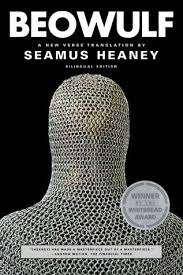
39. Epigram: witty aphorism.

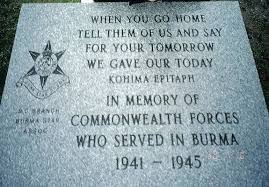
40. Epitaph: any brief inscription in prose or verse on a
tombstone; a short formal poem of commemoration often a credo written by the
person who wishes it to be on his tombstone.
41. Epithet: a short, descriptive name or phrase that may insult someone’s character,
characteristics

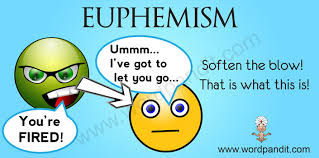
42. Euphemism: the use of an indirect, mild or vague word or
expression for one thought to be coarse, offensive, or blunt.
43. Evocative (evocation): a calling forth of memories and
sensations; the suggestion or production through artistry and imagination of a
sense of reality.

44. Exposition: beginning of a story that sets forth facts,
ideas, and/or characters, in a detailed explanation.

45. Expressionism: movement in art, literature, and music
consisting of unrealistic
representation of an inner idea or feeling(s).

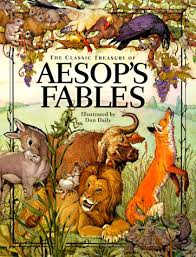
46. Fable: a short, simple story, usually with animals as
characters, designed to teach a moral truth.
47. Fallacy: from Latin word “to deceive”, a false or misleading
notion, belief, or argument; any kind of erroneous reasoning that makes
arguments unsound.
48. Falling Action: part of the narrative or drama after the
climax.

49. Farce: a boisterous comedy involving ludicrous action and
dialogue.

50. Figurative Language: apt and imaginative language
characterized by figures of speech (such as metaphor and simile).

51. Flashback: a narrative device that flashes back to prior
events.

52. Foil: a person or thing that, by contrast, makes another
seem better or more prominent.

53. Folk Tale: story passed on by word of mouth.
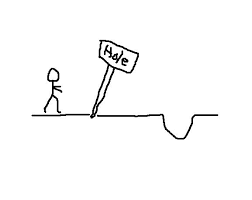
54. Foreshadowing: in fiction and drama, a device to prepare the
reader for the outcome of the action; “planning” to make the outcome
convincing, though not to give it away.
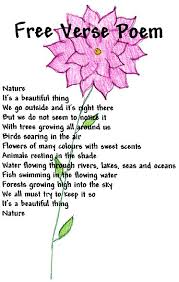
55. Free Verse: verse without conventional metrical pattern,
with irregular pattern or no rhyme.
56. Genre: a category or class of artistic endeavor having a
particular form, technique, or content.
Subscribe to:
Posts (Atom)